2016 was a big year for the Lifeline Program. The Federal Communication Commission (FCC) made the program more modern. This meant that supportive services offered by the program included broadband internet. The FCC not only added a supported service but improved its standards as well. The FCC made guidelines to make sure that there would be the best value to the service. In fact, the FCC also created a National Eligibility Verifier as a better application system.
How to Understand Your Eligibility
Those who would like the Lifeline program need to meet an income requirement of making 135% less than the standard indicated in the Federal Poverty Guidelines. If you and/or a member of your household register in one or more of the following programs, you will qualify for the Lifeline program:
- Supplemental Security Income (SSI)
- Federal Public Housing Assistance (FPHA)
- Medicaid
- Tribal Programs
- Supplemental Nutrition Assistance Program (SNAP)
- Veterans Pension
- Survivors Benefit
It is smart to have all of your documents ready when you apply. Online sources will go over what you need to have.
Application Process
The application process is pretty simple. Every applicant must finish an application on the National Verifier application system. Used by the FCC and run by the Universal Service Administrative Company (USAC), this centralized system verifies applicant eligibility.
Some US states are not in the digital National Verifier program. If you are living in one of those states or if you would like to explore alternative options to complete the application process, you will find more information here.
Cell Phone/Landline Service Providers
Lifeline works with two main cell phone providers SafeLink Wireless and Assurance Wireless. Both companies offer good packages not only for those who are in the Lifeline program but those who are either on food stamps or Medicaid. As for landlines, some of the biggest telephone companies, including AT&T and CenturyLink work with the Lifeline program and you can find a complete list here.
Know Your Rights
If approved for the Lifeline program, you have certain rights that your service provider must follow, which include:
- Providing at least 1000 minutes for cell phones
- Internet at home should have a speed of 25/3 Mbps with minimum usage of 1024 GB on a monthly basis
- A cell phone data plan of 3G and the right to use 4.5 GB on a monthly basis.
Frequently Asked Questions
What is the Low-Income Broadband Pilot Program
The FCC created a starter program back in 2012. The goal of this program was to get data to help understand the internet issues for low-income individuals. Cost, relevance, and the ability to get your message across digitally are all considered in this data.
This program specified that providers who were in the program had to collect and submit their data. Fortunately, your personal information doesn’t get impacted because the data is anonymous. Independent studies have used this information in order to best see what works and what doesn’t in providing universal service. This data was able to help them figure out some key parts of the problem.
Did the Coronavirus Change the Lifeline Program?
In order to help Americans during the time of the COVID-19 pandemic, the FCC decided to temporarily waive most documents that were required for subscribers who resided in rural areas. These documents included: recertification, verification, general de-enrollment, income documentation, and documentation requirements. Additionally, the FCC required that you provide three consecutive months’ worth of documents to prove your income level. On April 29th, 2020, this was temporarily waived. For those who live in rural Tribal areas, the FCC facilitated the enrollment of the Lifeline service for them. All of these changes remained in effect until September 30th, 2021. Unfortunately, the FCC did not extend this branch of the Lifeline Program (which can be a good thing, since it means that the worst is over and people need not as much extra assistance.)
]]>Things to Know About SNAP
SNAP is also commonly known as food stamps. This program can offer nutritional assistance to eligible low-income families and people. However, a majority of people who get benefits are from households with kids. This is an assistance option that the federal government funds to help low-income families. The federal government distributes the funds to states since states are in charge of operating the program.
If you get approval to receive SNAP benefits, then you will get an Electronic Benefits Transfer (EBT) card that gets deposited funds each month. Recipients get these funds and use them in locations that allow this type of payment. You also want to keep in mind that funds can only go towards eligible items! This article will tell you everything about SNAP.
Qualifying for SNAP
Various American households appreciate the help they get from SNAP. SNAP benefits make it easier for American households to deal with groceries. Generally, you need to know that eligibility requirements and benefit levels are widely standardized across America. States have the chance to update sections of the program since they are in charge of its operation. If you want to figure out whether or not you are eligible, then you will need to get in touch with your state agency and submit an application. They decide whether or not you qualify to get SNAP benefits.
These applications are free of charge, so you do not need to worry about wasting money. If you were able to get approval for benefits, then you can get benefits back from the date that you presented your application. You need to apply as soon as you can! The state defines eligibility criteria. You will find that the program prioritizes recipients based on their needs.
There are also some ineligibility criteria to keep in mind. That’s because some people may think they are eligible but actually aren’t. Higher education students, some legal immigrants, and people on strike cannot get food assistance, no matter what their income level. However, you should apply, even if you believe that you might not be eligible!
The application is free of charge and the worst that can happen is that you will be ineligible to get benefits. In that case, you will just move on to another assistance program. To keep it simple, you will not lose any money or any sleep!
SNAP Limitations: What are They?
Similar to other federal assistance opportunities, there are limitations on the benefits you will get from SNAP. However, every person’s situation is different, which is something that SNAP takes into consideration. One restriction that you might come across is that people who do not have kids can get up to three months of benefits. The only exception is that you need to work at least 20 hours per week or take part in qualifying assistance programs. In addition, states can decide to add other restrictions on SNAP benefits which include employment requirements, regulations, and so on.
How to Apply for SNAP Benefits
As we mentioned before, SNAP is a program that the federal government funds. In addition, the state is responsible for operating SNAP. That’s important to keep in mind because states will have their own application process. You should apply for SNAP in your current state. To begin the application process, you will need to get in touch with your state agency. There are different ways that you can contact your state agency, which include:
- Making an appointment with your local SNAP office
- Visiting your state agency’s website online
- Making a phone call to your state’s SNAP toll-free number
Depending on your state, you can fill out an online application. Once you send in your application, you can find out whether or not you are generally eligible within 30 days. During the time the program processes your application, you will need to attend an eligibility interview and confirm your income level. This will ensure that all the details and documents you present on your application are clear and verified. The protocol for the interview depends on each state. Usually, you can attend interviews on the phone or in person.
What Can You Purchase With Food Stamps?
Not every grocery item can be bought with SNAP funds. The grocery items that you can buy are as follows:
- Meat, Poultry, Fish
- Bread and Cereal
- Snack foods
- Fruits and Vegetables
- Dairy products
- Non-alcoholic beverages
- Seeds and/or plants that make food for the family to consume.
- Other foods that are similar to the ones listed above
Keep in mind that SNAP payments are not accepted to buy any and every kind of grocery. There are so many items that you are not allowed to purchase which include:
- Live animals (with certain exceptions)
- Vitamins, medications, supplements
- Alcoholic drinks such as beer, wine, liquor
- Tobacco products such as cigarettes
- Non-food products
Bottom Line
The Supplemental Nutrition Assistance Program is a popular food assistance opportunity that many individuals can gain from. If you are going through financial struggles, then you should consider applying for SNAP. It is a federally-funded program, but states are in charge of operating the program. This means that you will need to get in touch with your state’s agency when you begin your application. After presenting your application, you can expect to figure out your application status within 30 days. If the program accepts your application, then you will receive a certain amount of money per month on an Electronic Benefits Transfer (EBT) card. This card will automatically be refilled each month until your benefits expire.
The amount of benefits you get is based on several factors. This could include your family size, your income level, or more. If you have any questions, you should get in touch with your state’s agency. They can answer all of your questions and tell you about any limitations on SNAP benefits!
]]>The federal government created several housing assistance opportunities that aim to help with the growing housing issue. These programs mainly target low- and moderate-income individuals and families. The trick to finding the right program for you is to do your research and prepare any required documents. It’s also essential to only rely on information provided by official sources. In this article, we’ll take a look at some options you might want to look into and how you can apply for them.
What Is Government Housing Assistance?
Government housing opportunities are a series of housing programs available for low- and moderate-income families and individuals. The gist of it is that the federal government can provide affordable housing for people who potentially would be homeless otherwise. However, you must remember, every program comes with different perks and every program also comes with different terms of eligibility.
Housing Choice Vouchers (HCV)
Who doesn’t like a good voucher, right? Alright, so these are definitely worth more than your average supermarket vouchers. HCV, also known as Section 8 vouchers, are meant to give low-income families access to affordable housing. To put it simply, Housing Choice Voucher holders can rent a house, and only pay a fraction of the rent.
Here’s a bit of background information. So the program was created by the Department of Housing and Urban Development (HUD). The idea is to get low-income families to find homes that accept these vouchers. Families must also qualify as low-income, compared to the median income in their local area. Applicants must also head to their local Public Housing Authority (PHA) to start the applications. The PHA also serves as a great source of reliable information on this program, as well as other federal housing programs.
Here are a few things you should know before applying for HCV:
- You must qualify as low-income, compared to the median income of your local city/county
- You must find a house that accepts the vouchers on your own
- Down Payment/security deposit for the rented house is your sole responsibility
- You must pass a criminal background check
- Housing Choice Vouchers recipients end up paying around 30% of the rent, while the government takes care of the rest
Low-Income Individuals Can Also Get Their Own Rooms
Under Section 8 exists a program called Single Room Occupancy (SRO). It basically works the same way as the normal Housing Choice Vouchers, but for rooms, rather than full houses. The idea is to give very low-income and homeless individuals a safe room to live in. Rooms will often come as part of houses that have bathrooms, kitchens, living spaces, laundry rooms, and occasionally meeting rooms.
Transitional Housing
Starting off with what “Transitional Housing” actually means. The term refers to housing programs that aim to help individuals transition from unsafe housing/homelessness to eventual permanent housing.
Under the Continuum of Care (CoC) Homeless Assistance Program, the Department of Housing and Urban Development created a variety of solutions. Each solution tackles a different set of needs and different degrees of effectiveness towards that transition we mentioned before. We’ll list the different options offered, how long occupants can use them for, and how to be eligible for them.
Rapid Re-Housing
The first program we’re mentioning here has proven to be very effective in fighting homelessness. Rapid Re-housing is a program that aims to help individuals overcome the difficulties that lead them toward homelessness. These difficulties can be domestic abuse, drug addiction, mental health issues, or any other factor getting in the way of establishing a stable life.
With the help of qualified staff, individuals can work on improving their lives. The program will focus on improving individuals’ employability and social abilities. In the meantime, these individuals will have a safe space to call home, until they find their permanent homes.
Permanent Supportive Housing (PSH)
One can only imagine how difficult it can be to run a low-income family. Adding the factor of a disabled member, low-income families will be less likely to make ends meet. This is where PSH steps in.
Permanent Supportive Housing will provide long-term or lease housing, charging low rent rates. These housing solutions are exclusive to low-income families that include at least one disabled member. According to the Department of Housing and Urban Development, the term “disability” refers to any physical or developmental disability. It also refers to individuals suffering from chronic mental illnesses.
Not only will PSH provide affordable housing, but will also offer supportive services, to ease the lives of those families. These supportive services focus on both the disabled member(s) and the family as a whole. Here’s the list of supportive services PSH provides:
- Annual Assessment of Services
- Moving costs
- Case management
- Childcare
- Education services
- Employment assistance and job training
- Food
- Housing search and counseling services
- Legal services
- Life skills training
- Mental health services
- Outpatient health services
- Outreach services
- Substance abuse treatment services
- Transportation
- Utility deposits
What If I Need A Place To Stay Right Now?
There comes a time in every person’s life when things can get exceptionally difficult. In some situations, these difficulties can drive a person out of their home and onto the street. Thankfully, the federal government has built shelters in every state that can take in people for the night. Some shelters can also take people in for longer, we’ll look into that further down the article.
Types Of Shelters
Different shelters will serve different purposes. Some shelters are there to support the local homeless. Other shelters are present in case of an emergency. Finally, some shelters will take people to help them stand on their own 2 feet, and live more stable lives. So let’s talk about the different kinds of shelters available, shall we?
Homeless Shelters
This is the most common type of shelter. As mentioned above, shelters are available in every state across the country. You’ll probably find homeless shelters more often than any other type of shelter. Homeless shelters are there for individuals who are living on the streets. These individuals may struggle financially, or be victims of some sort of abuse. Homeless shelters will accommodate all those who need them.
In a homeless shelter, individuals will have their own bed to sleep on for the night. They will also have access to a warm meal. Most interestingly, homeless shelters will sometimes provide psychological and/or physical guidance. Moreover, after a person stays in a homeless shelter, they will be referred to other nearby shelters in case they need them in the future.
Homeless shelters will often only take in people for 24 hours at a time. So, residents only get to spend the night, before freeing up the bed for someone else. Homeless shelters also operate on a first-come-first-serve basis. That means for whoever needs one, needs to get in line, and there is a chance beds might run out before they get their turns.
If you’re in need of a homeless shelter, check out this map. All shelters across the country will be listed, and will also be organized by state and city. The page also provides information on alternatives to homeless shelters, if need be.
Emergency Shelters
This kind of shelter acts the same way a homeless shelter would. However, there are a few differences. First, emergency shelters are only available to those going through government-declared emergencies. These emergencies can be natural disasters or potential terrorist attacks. Second, emergency shelters will not only take in individuals, but also families going through the struggle.
On the other hand, the process of accessing an emergency shelter is the same as a homeless shelter. It’s also based on first-come-first-serve. Priority is given to those applying for help in person. Emergency shelters will provide temporary/brief accommodation before needing to free up space for other needy.
Transitional Shelters
Ok, so we talked about how residents of emergency shelters and homeless shelters can only stay around 24 hours. Things are different with transitional shelters. Transitional Shelters will take in residents for a period of 6-24 months. Much like Rapid Re-Housing, transitional shelters focus on helping their residents overcome difficulties. These difficulties can be the result of mental issues, addictions, or even domestic issues. During a resident’s stay, they will work with qualified staff on addressing these issues, and figuring out ways to improve their lives. The aim is to help these individuals transition to a stable life and a permanent home.
Public Housing
You might think you don’t want to stay temporarily in a homeless shelter. You might also not want to search for a house that will take Housing Choice Vouchers. If so, public housing is for you. Public housing is basically a series of housing projects built by the federal government. The idea is to provide subsidized housing (most commonly in apartment complexes), that charge low rental rates for low-income families.
Public housing focuses on empowering families and protecting them from homelessness and other kinds of housing instability. By saving money on rent, families will have more money to spend on food and other necessities. Public housing projects will also be situated near schools and other services. Public housing will also allow elderly people, as well as disabled individuals to stay.
Housing Loans
It’s safe to assume that having a permanent home leads to a more stable life, especially when it comes to families. Having a place of their own can be a deciding factor towards a stable upbringing. That’s why some low-income families and individuals will choose to buy their homes, instead of renting. As a result, the federal government created several loan programs to help families buy their homes. Every loan we’re about to mention serves a different situation, and also will require different qualifications. So, do your research and find the loan program that fits you best.
Rural Homeownership Direct Loan Program
You’ll find this program also under the name Section 502. The general idea of this program is to provide rural housing for low- and very-low-income families. The program provides “payment assistance to increase an applicant’s repayment ability. Payment assistance is a type of subsidy that reduces the mortgage payment for a short time. The amount of assistance is determined by the adjusted family income.”
To qualify for this loan, applicants’ homes must meet the following criteria:
- 2,000 square feet or less
- Meets loan limit requirements
- Does not have in-ground swimming pools
- Is not be used for income-producing activities
Farm Labor Housing Loans
This loan program will focus on financing domestic farm laborers to build their own homes. The program will help eligible candidates buy, build, improve and repair housing for farm laborers. These loans will have a 33-year payback period and a fixed 1% interest rate. Applicants for this loan should know that only the following list is allowed to live in this type of housing:
- Domestic farm laborers, including those working on fish and oyster farms and on-farm processing (1)
- Retired and/or disabled farm laborers
- Must be a U.S. citizen or permanent resident
- Very low- to moderate-income households
Veteran Affairs Loan (VA Loans)
As a show of gratitude towards our country’s military personnel, the federal government created a special housing loan. The Department of Veterans Affairs (VA) created a program to make it easier for veterans to apply for and pay back loans. Veterans (and their spouses) may apply for housing loans from private organizations, such as banks, and the loan will be guaranteed by VA.
VA itself will require no down payment, however private lenders might. VA will also ask for very low-interest rates, as well as limited closing costs. To put the icing on the cake, there will be no need for Private Mortgage Insurance. The VA loan is also a lifetime benefit.
Bottom Line
There are a variety of different assistance options that can help. Regardless of what you are dealing with, there may be federal assistance that can provide support. If you need extra help, you will want to talk to your local PHA to see what housing options are available in your area.
]]>If you are dealing with back pay, then you should know that most people are. This is because the process of a disability claim can take a while; the problem has nothing to do with you. You will find that the process takes an even longer time, in the case that you were denied but submit an appeal on the denied approval. Fortunately, the Social Security Administration will ensure that you receive the benefits that you were due. But, you should understand that finding out back pay can be a little complicated. This article will make it easier and simpler for you to understand.
How Does SSDI Back Pay Operate?
Back payments can go as far as the date of your original application, which could have been a while ago. An example from the AARP on how the SSDI back pay operates could make things easier. In this example, let’s say that you had arthritis that gradually got worse and stopped you from working on October 18th, 2020. After that, you applied for SSDI benefits on November 1st, 2020. Let’s say that the SSDI denied their approval for you to get benefits. Then, naturally, you submitted an appeal and received a hearing with an administrative law judge.
During the hearing with the judge, you will need to present evidence of your condition to get the judge to rule in your favor. If you are lucky and the judge rules in your favor, then you should receive disability benefits that date back to October 2020. The Social Security Administration would assess your SSDI benefit, depending on your previous earnings history to determine your benefit amount. Now, let’s say that your benefit amount was calculated to $1,200 per month. That would be a great help for your current situation. But, it’s 2022 and you still have not received a check since October 2020. What happens then?
This is where back pay comes into play. Historically speaking, 15 months have passed since you began managing your disability. The Social Security Administration will consider that date as your onset date. Typically, SSDI benefits have a waiting period of five months, according to the law. After the waiting period is over, then the SSDI benefits will start. This means that the benefits would take place the 6th full month after your onset date. Additionally, you have the right to receive 10 months’ worth of back pay.
How Does the Social Security Administration Manage Back Pay?
Once the Social Security Administration approves your claim, then the SSA has about 60 days to pay off your past-due SSDI financial benefits. Typically, you will receive back pay in a lump sum. Throughout the appeal process, you probably need to pay for legal representation for your disability case. In that context, the SSA is responsible for paying their fees from your back pay. So, you need to be very aware of the amount you should receive from the SSA.
The Social Security Administration is required to approve of the fee agreement with your legal representation in advance. This could be a lawyer or a legal advocate. Typically, you will find that the fee is capped at no more than 25% of your back pay or at $6,000. This depends on whichever is less. If the total amount of your back pay was worth up to $12,000, then you should expect your lawyer to receive a payment of $3,000.
You are probably wondering where the $12,000 came from. Do not worry; we did the calculations for you. Let’s say that your total amount of back pay is $12,000. That would come from $1,200 SSDI benefits from our previous example, multiplied by 10 months after the initial waiting period. Ta-da! That’s where $12,000 comes from.
Can I Only Get Back Pay from SSDI?
No, that is not the only way you can get back pay. You can actually get back pay when you are dealing with Supplemental Security Income (SSI). The SSI Program is another program that the Social Security Administration provides. You will find that the SSI Program is a state-run welfare program that offers payments to people with disability and low-income residents that meet other eligibility requirements. But, the back pay for the SSI Program works a little differently than the SSDI Program.
When you are looking at your back pay for the SSI Program, you will find that the start date of the payment is relevant to your application date. On the other hand, you will find that the SSDI focuses on your onset date. You will find that another advantage of the SSI Program is the fact that it does not have a waiting time frame, as opposed to the five-month waiting period for the SSDI Program.
These factors mean that the calculation for your back pay works differently than the SSDI Program. You should also note that if your total back pay amount was more than the SSI Program’s maximum monthly amount of $841 (as of 2022), then you probably will not receive it in a lump sum. Typically, you will receive it in three installments throughout six-month intervals.
What are the Most That I Can Get from SSDI or SSI Back Pay?
You should have a very clear and definitive understanding of how you deal with back pay for both the SSDI Program and the SSI Program. But, the main advantage of these back pay opportunities is that there is no maximum amount for either Program!
Does Back Pay Affect My Taxes? Partially, Yes. Here’s How!
You need to keep in mind that a part of Social Security benefits is taxable. This means that a section of your back pay could be taxable, in the case that your total income surpasses a specific limit. Fortunately, the Internal Revenue Service (IRS) is fully aware of that and offers individuals the chance to minimize their chances of exceeding the income limit. The IRS allows an individual to refigure their back pay amount from the previous year and roll it into that year’s income for tax purposes. That way, you have the opportunity to minimize your chances of passing the limit. You will find that the IRS refers to this as a lump-sum election.
In Conclusion
Back pay could be a confusing concept. But, it does not need to be. Officially, back pay is known as past-due benefits. Back pay is the funds you receive from the date you applied for benefits until the date you actually received approval to get those benefits. This is because it can take a while to deal with a disability application and get approval. But, you need to keep in mind that the SSDI benefits you receive have a five-month waiting period. But, there is no waiting period for the SSI Program.
]]>What is SNAP?
Also known as food stamps, this program can give nutrition support to qualifying households dealing with financial hardship. This means families, people with disabilities, seniors, and more may be able to benefit. While this program may be able to help a bunch of different types of households, a majority of recipients are families that have children.
Since this is a government program, it is federally funded (even though states may contribute to the cost). However, the states will be the ones to manage the program. If a recipient is eligible to receive assistance, they will get funds every month on an electronic benefits transfer (EBT) card. People can use this card at locations that allow it as a form of payment.
Who is Eligible for SNAP?
Even though there are a lot of Americans dealing with financial hardship, not everyone will be able to qualify for this program. It is important to note that eligibility requirements vary by state but you can generally expect similar qualification requirements no matter where you go. If you want to confirm your eligibility status you will need to get in touch with your state agency.
Your state agency will be the one to determine your eligibility status based on your information. Another benefit to this program is the fact that these applications are free! The best part? If you are approved you will be able to receive benefits all the way back from the date that you handed in your application!
Even though you think you may be eligible, that may not be the case. That is why it is not only important to check your eligibility with your state agency but you will also want to keep ineligibility guidelines in mind. Ineligibility guidelines include certain groups of people that will likely not be able to receive benefits like:
- Most college students
- Some legal immigrants
- Individuals on strike
However, even if you may be ineligible, it doesn’t hurt to submit an application since they’re free. The worst that can happen is that you get rejected from SNAP benefits.
Are There SNAP Restrictions?
Since this is a federal assistance program, there are restrictions on benefits that are important to keep in mind. For example, a majority of childless adults can only receive up to three months of benefits unless they work a minimum of 20 hours a week or are a part of a qualifying program. States have the ability to set restrictions like this which is why it is important to see what the guidelines are for your area.
How Much Will You Receive?
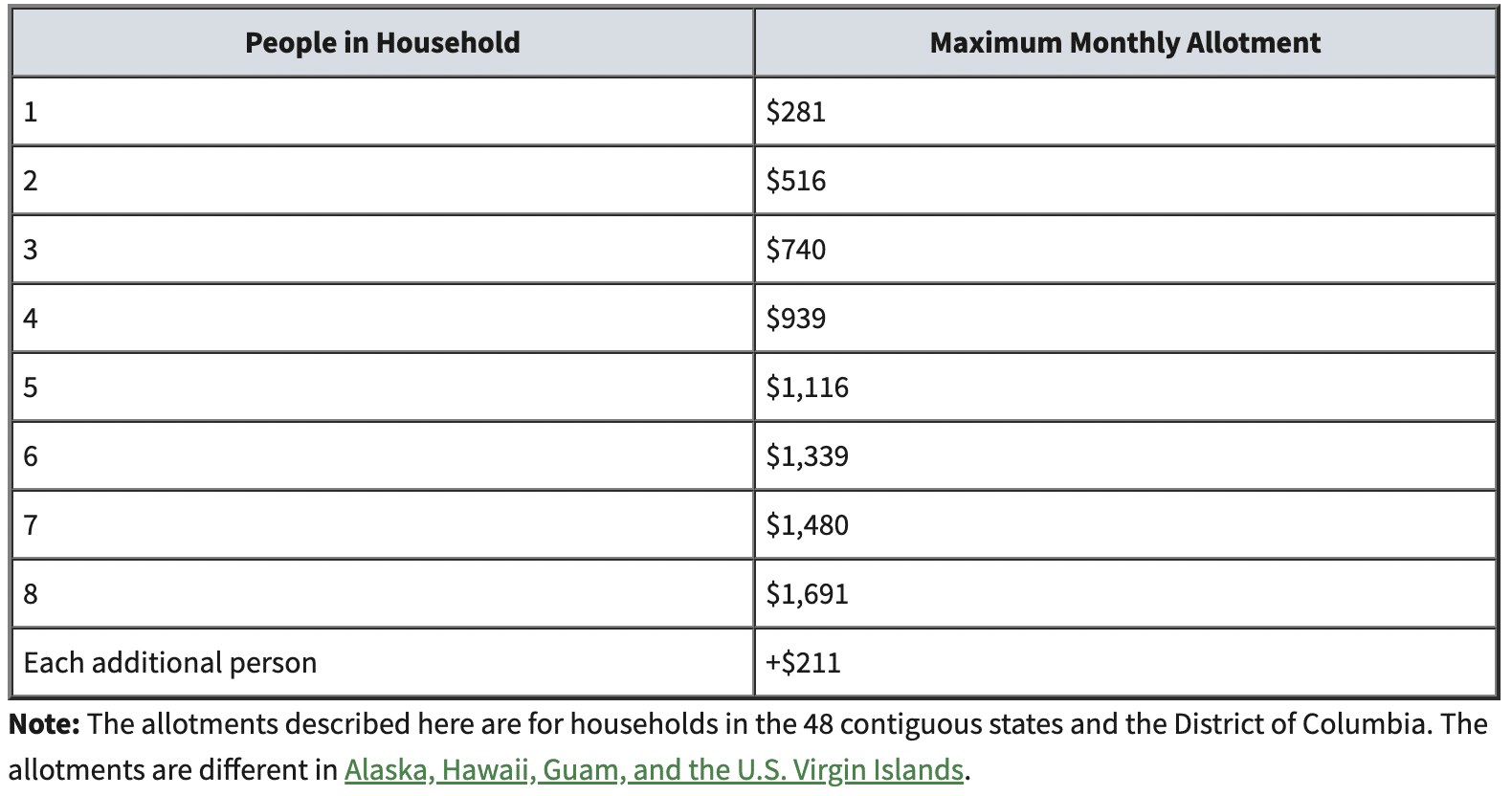
The amount of SNAP assistance you will be able to receive is calculated by multiplying your household’s total income (referred to as net income) by 0.3. That is because households are expected to spend 30% of their own resources on groceries. Once you get that number you will need to subtract the result from the maximum monthly SNAP benefit amount that your household size can receive. The math can be a bit complicated but you won’t have to worry about that since your state’s agency is the one to calculate this number based on the information you provide. The United States Department of Agriculture (USDA) also created a table that shows the maximum monthly SNAP benefits allowed based on household size:
How to Submit a SNAP Application?
Each state will have its own application process. That means one state will likely have a different process from another state. Some states may allow online applications, others will not, etc. You can start the process by getting in touch with your state agency by:
- Visiting your local SNAP office
- Going to Your State Agency’s Website
- Calling Your State’s SNAP Toll-Free Number
Once you fill out and submit an application, you can generally expect to find out the results within 30 days. While your application is processing you will need to finish an eligibility interview as well as provide necessary documentation like income verification, personal information, etc.
What Can SNAP Benefit Funds Buy?
The funds that an individual receives on their EBT card cannot be used everywhere. Instead, they can only be used to purchase grocery items like:
- Bread
- Cereal
- Dairy Products
- Fish
- Fruits
- Poultry
- Meat
- Non-Alcoholic Beverages
- Other Foods
- Snack Foods
- Vegetables
While SNAP can cover a lot of grocery items, there are still other popular items that EBT cards cannot buy like:
- Alcoholic Beverages
- Live Animals (with Exceptions)
- Medicines
- Non-Food Items
- Supplements
- Tobacco Products
- Vitamins
Alternatives to SNAP Assistance
While SNAP is a great option to consider, there are other food assistance programs that can help Americans in need. Other programs that can help include:
- The Emergency Food Assistance Program (TEFAP)
- Special Supplemental Nutrition Program for Women, Infants, and Children (WIC)
- Farmers’ Market Nutrition Program (FMNP)
The Emergency Food Assistance Program (TEFAP)
TEFAP is a federal program that can help Americans in financial need supplement their diet through emergency food assistance. The USDA offers this program and they purchase nutrient-rich, high-quality food. Once they purchase this food they make it available to state-distributing agencies like food banks, soup kitchens, food pantries, etc. The amount of food that each state will receive varies based on the number of people on unemployment and those who are low-income.
Special Supplemental Nutrition Program for Women, Infants, and Children (WIC)
WIC is a specialized food assistance program aimed to help women, infants, and children up to 5 years old who are at nutritional risk. There are two main types of nutrition risks that impact WIC eligibility which are medically-based risks and dietary risks. Medically-based risks include individuals who are underweight, anemic, have poor pregnancy outcomes, etc. Dietary risks include failure to meet current dietary guidelines for Americans, inappropriate feeding practices/nutrition, and more. This program can help support individuals by providing nutritious goods, teaching nutrition education, giving health referrals, health screenings, etc.
Farmers’ Market Nutrition Program (FMNP)
FMNP is a program that works in association with WIC. WIC recipients may be eligible to receive FMNP coupons on top of their normal WIC benefits. These coupons can go towards the cost of qualifying foods from farmers, farmers’ markets, or roadside stands. Regardless of the source, they must be approved by the state agency to accept them as a form of payment! This can help provide WIC recipients with even more support with the cost of groceries.
Overall
SNAP is a very helpful program that provides support to millions of Americans in need. It can provide individuals with funds every month on an EBT card that can go towards handling the cost of groceries. The amount of assistance that a household can receive depends on factors like household size, income level, etc. Even though this is a federal program, states are the ones to manage it. This means that the programs will vary based on your location! If you need more information you will want to get in touch with your state’s agency. Besides SNAP, there are other food assistance programs that may be able to help like TEFAP, WIC, and FMNP!
]]>Assess Your Budget Plan:
If you are having trouble paying your rent while you still have a job and a consistent source of income, then perhaps you need to have a moment of honest self-accountability. Either the problem is with how much money you are making or how much money you are spending. If you feel that the money you are making should enable you to pay the rent, then you need to come up with a better budget plan that cuts out all the indulgences so that you can invest your limited monetary resources in all the essentials instead. However, the fact also could be that your income is simply not sufficient to meet all your living needs.
Creating a budget plan based on your needs will be a great first step. This financial insight can provide you with the proper map you need to manage your money in the best way for your situation. You may want to consider professional help if you are struggling to create a budget plan on your own. Experts have years of experience within that field to show you the best ways you can create a budget. There are also tools online, and apps on your phone that can assist as well. You have a variety of tools, make sure you use them!
Communicate with Your Landlord:
Choose the path of diplomacy rather than the path of war. It’s important to tell your landlord that you have been hitting hard times, especially when there is an ongoing pandemic that has been affecting business. Laws have been put in place to prevent evictions, but it is still important that you open up communication with your landlord on this matter so that it does not become an even bigger issue later on.
Develop an Awareness of Rights:
As a tenant, you have a certain set of rights that you are entitled to and it’s important for you to know them so that you are not taken advantage of by your landlord or anyone else. There are many sources that you can use to educate yourself about the rights that you have as a tenant. This includes:
- Eviction Lab gives you details of all the latest eviction policies: COVID-19 and Changing Eviction Policies Around the Nation (evictionlab.org)
- Information on rental relief and tenant’s rights is also available on the US Housing & Urban Development (HUD) Department (hud.gov)
- Regional Housing Legal Services (RHLS): Eviction Moratorium Maps – RHLS
- Community Resources | Just Shelter
Explore the Different Rent Relief Options:
There are several rental options you can explore if you have trouble paying your rent. The first thing we recommend you do is to consult the National Low Income Housing Coalition (Rental Assistance | National Low Income Housing Coalition (nlihc.org) and they can tell you about the rental relief initiatives in your locality. In addition, you can also consult 211.org as well as the Fannie Mae Disaster Response Network (Disaster Resiliency and Relief | Fannie Mae)
One popular program that has been created as a result of COVID-19 is the Emergency Rental Assistance Program (ERAP). This program is a part of the Consolidated Appropriations Act of 2020. $21.5 billion is available for households that cannot pay rent and utilities. These federal funds will be provided to states, local governments, Indian tribes, and U.S. Territories directly. This means that each locality has its own obligation to create an assistance program and allocation plan for the funds they receive.
You can also find available resources through a quick internet search. Organizations have compiled lists of existing rental assistance opportunities by the state which can be easily found online. You can use these lists as a reference when talking to your local public housing authority (PHA) about housing assistance near you.
Overall
It can be a challenge handling rent, especially during unprecedented times. Besides handling your own finances, there are programs that can help. There are a variety of assistance options available. The best place to start looking for housing assistance is with your local public housing authority (PHA). Here they can provide you with information about federal, state, and local program availability! Once you have that information you can begin the process of finding rental assistance options that are right for your situation!
]]>What HUD Housing Assistance Options are Available?
A lot of people may not realize that there are housing assistance options available from HUD for a variety of different housing needs. Some of these options include:
- Good Neighbor Next Door (GNND) Program
- Housing Choice Voucher Program
- Public Housing
- FHA Loans
- HUD Homes for Sale
- Housing Opportunities for Persons with AIDS (HOPWA)
Good Neighbor Next Door (GNND) Program
Not every program helps the same group of people in the same way. The GNND program is a great example of that. This program is only designed to help those that work in a qualifying profession. This includes those that are:
- Teachers (from pre-kindergarten to 12th grade)
- Firefighters
- Emergency Medical Technicians (EMTs)
- Enforcement officers of the law
Individuals that work in one of these eligible professions can benefit from this program. Through the GNND program, recipients can get a 50% discount on a home’s listing price. However, other rules come along with this program. For example, recipients must live on the property as their primary residence for a minimum of three years (36 months). Besides that, the properties that people can purchase must be located in qualifying revitalization areas to receive the discount. Only certain properties are available through this program!
Housing Choice Voucher Program
One of the most popular housing programs on this list is the Housing Choice Voucher program. It also goes by the name of Section 8. Through this program, qualifying recipients can get housing vouchers. These vouchers go towards the cost of housing in the private market. While it generally is designed to help with rental costs, some areas allow vouchers to go towards buying a property. Recipients will need to find the home they wish to move into in the private market. However, the properties must accept the vouchers as a type of payment as well as meet other criteria like a housing inspection. Even though this is a federal program, it is managed locally by Public Housing Authorities (PHAs). These PHAs have the responsibility of managing and administering the program. They are also where applicants can submit their applications and ask any questions they may have. This program is designed to help those in need so, to qualify, local PHAs will look at eligibility criteria like:
- Income Status
- Citizenship Status
- Family Status
- Criminal and Eviction History
Public Housing
Another popular housing assistance option is public housing. This housing support program is designed to provide housing to recipients at a rate they can afford. Oftentimes, when people picture public housing in their minds, they think of apartments. However, public housing can come in a variety of types of housing. For example, public housing could be in the form of a single-family home. Similarly to the Section 8 program, this program is managed at the local level by a housing agency (HA). Since it varies by locality, the specific eligibility criteria will be different depending on where you live. However, individuals can expect the local PHA to consider the following criteria when determining whether or not a person qualifies:
- References
- Income Status
- Family Status
- Citizenship Status
You may see references and think, “what is this? A job interview?” However, references provide good feedback for the HA to use when considering whether or not an applicant will be a good tenant. This is important because even if someone qualifies for the other eligibility requirements, they could still be denied if their references don’t check out. If you want to get started, you will need to reach out to your local HA.
FHA Loans
The Federal Housing Administration (FHA) is an agency of the HUD. This agency will insure loans that eligible lenders will offer to borrowers. Through insuring these loans, the agency reduces the risk that lenders have to deal with. It’s a layer of protection against losses so lenders can expand who they provide loans to. The protection focuses on paying a claim for any principal balance that remains in scenarios where the borrower defaults on their loan. Some of the biggest benefits of this loan are the fact that borrowers could qualify with:
- Lower down payment requirements compared to some conventional home loans
- Lower credit score requirements compared to some conventional home loans
Some common types of FHA loans include the following:
- Home Equity Conversion Mortgages (HECMs): Many people know these loans as reverse mortgages. The fact that it is a reverse mortgage means only seniors that are at least 62 years old can qualify for this type of loan. The benefit to these loans is that people can tap into their home equity to get cash, all while keeping the title!
- Section 245(a) Loans: This type of loan is an excellent option for those that expect to have their incomes grow. This loan starts with a low monthly payment which increases over time.
- 203(k) Improvement Loans: Not every home is available in the same condition. Some properties need a little fixing up. This type of loan accounts for that! This loan provides additional funds that can go towards the cost of improving the property through repairs, renovations, etc.
- Energy-Efficient Mortgages: Some homes are more energy efficient than others. Those that want to improve their home’s energy efficiency, can get this type of loan. This loan comes along with additional funds that cover the cost of making the home more energy efficient.
HUD Homes for Sale
There are plenty of different properties to consider when looking to buy a house. One type of property, in particular, is foreclosed homes. However, not every foreclosed home is the same. Some foreclosures are exclusively offered by the HUD. The reason that these homes are available through HUD is that the home that went into foreclosure was from an FHA loan. To view these listings specifically, you can check out the HUD Home Store. However, if there is a home that catches your eye then you will need to reach out to a government-registered broker!
Housing Opportunities for Persons with AIDS (HOPWA)
Last but not least on this list of HUD housing assistance options is HOPWA. This program doesn’t benefit a community directly. Instead, it provides grants to sources within a community that can provide housing support (as well as other helpful services).
Bottom Line
When it comes to housing support, there are a variety of options to consider. There are assistance opportunities at the local, state, and federal levels. However, this article focuses on some of the federal assistance options that may be able to help. These assistance options are available thanks to HUD and include the following:
- Good Neighbor Next Door (GNND) Program
- Housing Choice Voucher Program
- Public Housing
- FHA Loans
- HUD Homes for Sale
- Housing Opportunities for Persons with AIDS (HOPWA)
Regardless of the housing assistance option, it’s important to know that there is more help out there than you may realize. You just need to know some options to consider!
]]>- Social Security Retirement Benefits
- Social Security Disability Insurance
- Supplemental Security Income
Social Security Retirement Benefits
Most people are familiar with Social Security retirement benefits. These benefits will replace a part of an individual’s pre-retirement income. The replacement amount depends on an individual’s largest 35 years of earnings. The specific amount of benefits that a person can receive will vary on a variety of factors. One of the biggest factors is age. That’s because an individual can only begin getting these benefits once they turn 62 years old.
In order to benefit from this assistance, a person will need to work and pay Social Security taxes. Once a person does this, they are able to earn “credits”. These credits will go towards how much benefits a person can get. The specific number of credits that a person will need to qualify for this assistance depends on the year that they were born. For example, anyone born after 1929 will need a minimum of 40 credits. Generally, this translates to about 10 years of work.
If you stop working before you have enough credits, you are still in luck. That’s because the credits that you earn will remain on your Social Security record. If you do decide to return to work later, you have the chance to have more credits added. You will need to reach a minimum of 40 credits (if you were born after 1929) in order to benefit from this assistance opportunity.
How Much Can You Get?
The amount you will get depends on a variety of different factors. However, the maximum benefit for 2022 is $4,194. There are ways that an individual can maximize their benefit! Some ways to maximize the amount you can get from this assistance opportunity include:
- Retire when you are 70
- Make the highest taxable income
- Have at least 35 years of qualifying work history
What to Know About Earnings?
Generally, Social Security earnings are calculated the same for a majority of workers in the United States. However, there may be some additional rules depending on the type of earnings. Some earnings that have special rules include:
- Farm Work
- Federal Government Employment
- Household Employment
- Military Service
- Nonprofit or Religious Organizations
- Railroad Earnings
- Self-Employment
- State And Local Government Employment Wages
- Work Outside The United States
What Will the Application Process Look Like?
You can apply online, over the phone, or in person. You can expect to provide information about yourself. This would include details like your:
- Date of birth
- Place of birth
- Social security number
- Name
- Children’s names
- Financial information
- Work information
Social Security Disability Insurance (SSDI)
Another assistance opportunity for people is SSDI. This is an opportunity that can help insured individuals that have an eligible work history and qualifying disability. Eligible family members may also be able to receive benefits from this support opportunity. Eligible family members include:
- Spouses
- Divorced Spouses
- Children
- Disabled Children Up Until 22 Years Old
How to Qualify for SSDI?
If you want to get benefits from SSDI then there are some qualifications you need to meet. That’s because this support opportunity is designed for individuals that have a qualifying disability that makes it impossible for them to continue working. In this case, a person would basically need to retire early due to their condition. That is why work history also plays a role in eligibility. The two main factors of eligibility are if a person:
- Has worked in job that Social Security covers
- Has a medical condition that meets the SSA’s definition of disability.
If a person begins receiving benefits from SSDI, they will do so until they reach the full retirement age (FRA). At which point, their SSDI benefits will convert to the standard Social Security retirement benefits that we were talking about above.
What is the Definition of Disability According to the SSA?
The SSA will look at 5 questions when determining if an individual’s disability qualifies. The 5 questions are:
- Is the Person Working?
- Does the Person Have a “Severe” Condition?
- Is the Condition Listed on the SSA’s List of Medical Conditions?
- Does the Person’s Condition Make it Impossible to Do Work That Was Done Previously?
- Is It Possible to Do Any Other Type of Work?
How Much Can You Get from SSDI?
The maximum SSDI benefit is $3,345 for 2022. However, it is hard for people to get that maximum amount. This is why on average the typical SSDI payment is $1,358 for 2022. It’s a common misconception that the amount that a person will get depends on the severity of their disability. Instead, the benefit amount will depend on a calculation that uses a person’s covered earnings over a period of time. This amount is known as your average indexed monthly earnings (AIME).
What’s the Application Process Look Like?
It’s important to remember that the specific application process can vary by state. However in general the application process will look something like this (regardless of whether you do it by phone, in person, or online):
- You will need to get together relevant information and documentation to apply. You will want to review the Adult Disability Checklist.
- Once you get your documentation together you will complete your application.
- After your application is complete you will submit it.
- Once you submit your application the SSA will review it to make sure you meet the minimum requirements for disability benefits. They also consider your work history and any current work activities.
- Afterward, the SSA will process your application and forward your case file to the Disability Determination Services office for your state.
- Once your state’s Disability Determination office receives this information, they will make a decision.
Supplemental Security Income (SSI)
Finally, on this list of SSA programs is SSI. Individuals that can benefit from this assistance need to be 65 years old and in financial need. However, an individual can be younger than 65 years old if they have a qualifying disability and are in financial need. Even though this is another program opportunity that may be able to help individuals with a disability, it is important to remember that it’s completely separate from SSDI. This program does share some similarities with SSDI. That’s because the medical requirements are the same. In fact, a person may be able to get SSI and SSDI at the same time!
How Much Can You Get from SSI?
This program has a far lower maximum benefit than the other options on this list. For 2022 the maximum amount that a person could get from this program is:
- $841 a month for an eligible individual
- $421 a month for an eligible essential person
- $1,261 a month for an eligible couple
What’s the Application Process Look Like?
If you have a disability and are applying for SSI the application will look similar to SSDI. However, it will depend on your specific circumstance. For example, if you are applying for SSI and do not have a disability then you will not need to worry about providing that information or meeting disability requirements. It is important to make sure you review the basic requirements that come along with SSI eligibility to see if you may be able to benefit.
Bottom Line
The Social Security Administration (SSA) has a variety of programs that can help people in need. Each opportunity has its own set of eligibility requirements and program benefits. It’s also important to remember that it can vary by state. The best way to get detailed, up-to-date, accurate information is by getting in touch with your local Social Security office. They can provide resources you need to better understand what assistance is available.
]]>Your Guide to SSI
This program is available through the Social Security Administration (SSA). People can benefit from this program thanks to the payments they receive every month. The payments that recipients get can go towards a variety of necessary expenses:
- Shelter costs
- Groceries
- Clothing
Eligibility Requirements for SSI
This program is designed to help people that have a limited amount of resources and a limited income who have eligible citizenship status. Besides that, to qualify applicants must be at least one of the following:
- Disabled
- Blind
- 65 years old or older
There are some instances where a person can automatically qualify for this support opportunity. People may be able to do this if they are currently benefiting from other government programs. For example, a person may automatically qualify if they are receiving benefits from Social Security Disability Insurance (SSDI). Besides the above-mentioned qualifications, some other qualifications for this program include:
- Don’t be absent from the country for a full calendar month or 30 consecutive days
- Have an eligible residency status
Regardless of whether or not you think you may qualify, the applications are free! Submitting an application is the only true way to tell eligibility and they won’t cost you a penny. So, they are for sure worth the time it takes to submit one!
What Does Disability Mean?
It’s important to note that someone may have a disability with a limited amount of resources and income but still may not qualify. That’s because only a specific type of disability qualifies for this program. Only disabilities that meet at least one of the following criteria qualify for this program:
- Causes the inability to perform any substantial gainful activity (SGA)
- Is expected to last for at least 12 months or result in death
- Lasted for at least 12 months
Ineligibility to Keep in Mind
While it is important to keep the eligibility criteria in mind, there are instances where people can find themselves ineligible. This includes people who:
- Are in either prison or jail or a public institution
- Have an unsatisfied arrest warrant or felony
- Give away the resources they receive
What’s the Most You Can Get From SSI?
The specific amount that you will be able to get from SSI will vary depending on your situation. However, the maximum monthly limit for 2022 is:
- $841 for individuals
- $1,261 for a couple
What are the Limits for SSI
Remember how we said this program was designed to help people with limited resources and income? Well, that means there will be limits that applicants face when qualifying.
Resource Limits
Applicants can only have a maximum of:
- $2,000 in resources as an individual
- $3,000 in resources as a couple
Luckily, not everything is considered a resource. Only the following are considered when determining how many resources an applicant has:
- Cash, bank accounts, and mutual funds
- Stocks and United States savings bonds
- Personal property
- Life insurance
- Land
- Other items that could be converted to cash and used for necessities like shelter or food
It’s important to remember that not everything will count as a resource! If you have any questions about what does and doesn’t count, you can reach out to the SSA.
Income Limits
For 2022, the income limits that applicants must make less than are the following:
- $1,767 for Individuals
- $2,607 for a Couple
Not every source of income will count towards this limit. In fact, the following forms are not counted by the SSA when determining the level of income:
- Income tax refunds
- Education grants
- The first $20 that an applicant gets for the month
- Supplemental Nutrition Assistance Program (SNAP) benefits
- Home energy support
- Uncommon small amounts of random income
What’s the Application Process for SSI?
Many people don’t realize that there are a couple of different ways they can apply to this program. A person can apply:
- By calling
- Going Online
For those that want to apply by calling, they can reach out to 1-800-772-1213 (or TTY 1-800-325-0778 if they are hearing impaired). Another number that hearing-impaired people can call is 1-800-772-1213 which is a number that is compatible with telecommunications relay services (TRS). On the other hand, those that want to apply online will have a different process. Generally, the online application process takes a maximum of 10 minutes.
When submitting an application, people can expect to provide information like:
- Personal information: name, date of birth, and Social Security Number
- Contact information: mailing address, phone number, and email
Regardless of how you choose to apply, you will want to do it as soon as you can! Applications take time to process and when you are in need, waiting can be extra challenging. When you submit your application quickly, that means you will get your benefits quicker than if you just wait around!
Bottom Line
For qualifying individuals that have a limited amount of income and resources, one support opportunity is Supplemental Security Income (SSI). Besides having limited income and resources, recipients will need to also be at least 65 years old, have a disability, or be blind. This program provides support through payments that recipients get each month. The maximum monthly amount of benefits that recipients can get is:
- $841 for individuals
- $1,261 for a couple
It’s easy to apply! If you want to get more information about this program or want to begin the application process you should check out the SSA. Who knows? This support option may be a great resource for what you’re dealing with!
]]>Details About SNAP
The Supplemental Nutrition Assistance Program is referred to as food stamps. It can provide nutritional support for qualifying low-income households and individuals. This includes families, seniors, people with disabilities, and much more. This program helps many groups of people, but a majority of those who receive benefits are families with children. This is a program that the federal government funds to help low-income households. They divide the cost of funding the program with states since states are responsible for operating the SNAP.
If you receive approval to receive Supplemental Nutrition Assistance Program benefits, then you will get an Electronic Benefits Transfer (EBT) card that transfers money each month. The funds that you receive can be used in locations that accept this form of payment. If you qualify for this type of assistance, then you should figure out how long you will receive the benefits. This article will tell you everything you need to know about the Supplemental Nutrition Assistance Program, from start to finish.
Are You Eligible For SNAP?
There are many Americans that like the assistance that they receive from SNAP. This is because the SNAP benefits make it easier to manage the cost of groceries. A general rule of thumb that you need to remember is that the eligibility requirements and benefit levels are broadly standardized across the United States. States have the ability to update parts of the program since they are responsible for operating it. If you are interested in finding out whether or not you qualify, then you will need to reach out to your state agency. They define whether or not you are eligible to receive SNAP assistance. These applications are free of charge! If you receive approval for the benefits, then you can receive benefits back from the date that you sent in your application. This means that you should apply as soon as possible.
The state determines the eligibility requirements. But, you can expect to find that recipients are prioritized based on needs. If you are in a household that falls into the extremely low-income category, then you will receive more assistance. Make sure that you remember that ineligibility for the Supplemental Nutrition Assistance Program can relate to your current situation. There are many people that consider themselves ineligible before they figure it out. That is because most college students, some legal immigrants, and those on strike are unable to receive nutritional assistance, regardless of their income level. But, you should submit an application, even if you think you may not qualify.
Just Apply!
The application is free and the worst thing that can happen is you will be unqualified to receive benefits. In that case, you can move on to another assistance option. Simply put, you will not lose any sleep!
What are the SNAP Restrictions?
Similar to other federal assistance programs, there are restrictions on the benefits you will receive from SNAP. But, every person’s situation is unique and the Supplemental Nutrition Assistance Program takes this under consideration. You will need to confirm the status for yourself. This means that you need to contact a professional. One limitation that you might come across is that individuals without children can receive up to three months of benefits. The only exception is that you work a minimum of 20 hours a week or participate in eligible programs. Additionally, states can choose to impose other limitations for SNAP benefits such as work requirements, guidelines, etc.
Basically, there are specific restrictions that a state can impose at any point in time for SNAP benefits. But, you should not think too much about it. Additionally, make sure that you remain in constant contact with your state’s local agency. They will help you figure it out and stay by your side through every step of the process.
How Much Can You Get from SNAP?
An allotment means the SNAP benefits that you receive from the program. Typically, the program calculates benefits by taking into consideration that you will only use 30% of your income to purchase food. Fortunately, the United States Department of Agriculture (USDA) created a table that lets you know the maximum amount of benefits you can expect, as a household. As an example, a one-person household can receive a maximum monthly allotment of $281. Another example would be that a four-person household can receive a maximum monthly allotment of $939. This is why household size and income levels are important factors in determining your SNAP benefits.
Applying for SNAP Benefits
As mentioned earlier, SNAP is a program that the Federal Government funds. Additionally, the state operates the SNAP. This means that states have their own application process (we know we may sound like a broken record!). So, you will find that the process could be different from one state to another. This is why you will need to apply for SNAP in the state you are currently staying in. To start this process, you will need to contact your state agency. You can do this through different methods. There are different ways, including:
- Visiting your local SNAP office
- Going to your state agency’s website
- Calling your state’s SNAP toll-free number
It depends on your state, but you should be able to fill out an online application. Make sure to review your options when you start working on the application process. Once you submit your application, you can expect to find out whether you qualify or not within 30 days. By the time your application is in the process of getting processed, you will have to go through an eligibility interview and prove your income level. This will guarantee that the details and documents you provide on your application are accurate and clear. The protocol for interviews varies with every state. Typically, you can go through interviews over the phone or face-to-face.
There are some exceptions where some individuals can receive benefits sooner than 30 days. It is possible that some recipients could receive SNAP benefits within 7 days of the date on their applications. As long as they meet other eligibility requirements and qualify for the program, there is a possibility to receive the benefits earlier than 30 days.
What Can You Buy With Food Stamps?
Keep in mind that there are restrictions that prevent you from using the SNAP benefits on. You will be able to buy groceries such as:
- Meat
- Poultry
- Fish
- Bread
- Cereal
- Snack foods
- Fruits
- Vegetables
- Dairy products
- Non-alcoholic beverages
- Seeds and/or plants that produce food for the household to eat.
- Other foods similar to the ones mentioned above
Unfortunately, SNAP funds are not allowed to purchase every type of grocery. There are some ineligible items that you cannot buy. This includes:
- Live animals (except shellfish, fish removed from the water, and animals slaughtered before store pickup)
- Vitamins
- Medicines
- Supplements
- Alcoholic beverages like beer, wine, liquor
- Tobacco products like cigarettes
- Non-food items
Conclusion
The Supplemental Nutrition Assistance Program is a popular nutritional assistance option that many people benefit from. If you are dealing with financial hardship, then you should think about applying for SNAP. It is a federally-funded program, but states operate the program. This means that you will need to contact your state’s agency when you start the application process. After submitting your application, you can expect to find out your application status in 30 days. If you receive approval, then you will get a monthly amount of money on an Electronic Benefits Transfer (EBT) card. This card automatically gets refilled every month until your benefits reach their expiration date.
The amount that you will receive as benefits depends on many factors. This could include your household size, your income level, or more. If you have any questions, then you should contact your state’s agency. They will be able to clarify information for you on the program. You can also ask them about the restrictions of the SNAP benefits.
]]>